

Microchipping vs. GPS: Do You Need Both? (Short Answer: Yes. Here's Why.)
Jun 17, 2026
Her name was Biscuit, and she was gone before the gate finished swinging shut.
Darla had two thoughts in that order: first, at least she's chipped, and second, she's chipped, so I need to wait for someone to bring her in. Which is what she did. She posted on Nextdoor, she drove the neighborhood twice, she called the nearest vet. She waited.
Thirty-six hours later, a shelter forty minutes away called. Biscuit had been picked up by Animal Control the morning she went missing. She was fine. The chip was registered. Everything worked exactly as it was supposed to.
But here's the thing that stuck with Darla. Biscuit had been in that shelter for a day and a half. Darla was twelve miles away, not knowing. If she'd had a GPS tracker on that collar, she'd have known exactly where Biscuit was within ten minutes of her leaving the yard.
The microchip got Biscuit home. GPS would have gotten her home the same morning.
Those are two completely different tools solving two completely different problems. And most dog owners assume they do the same thing.
What a Microchip Actually Does
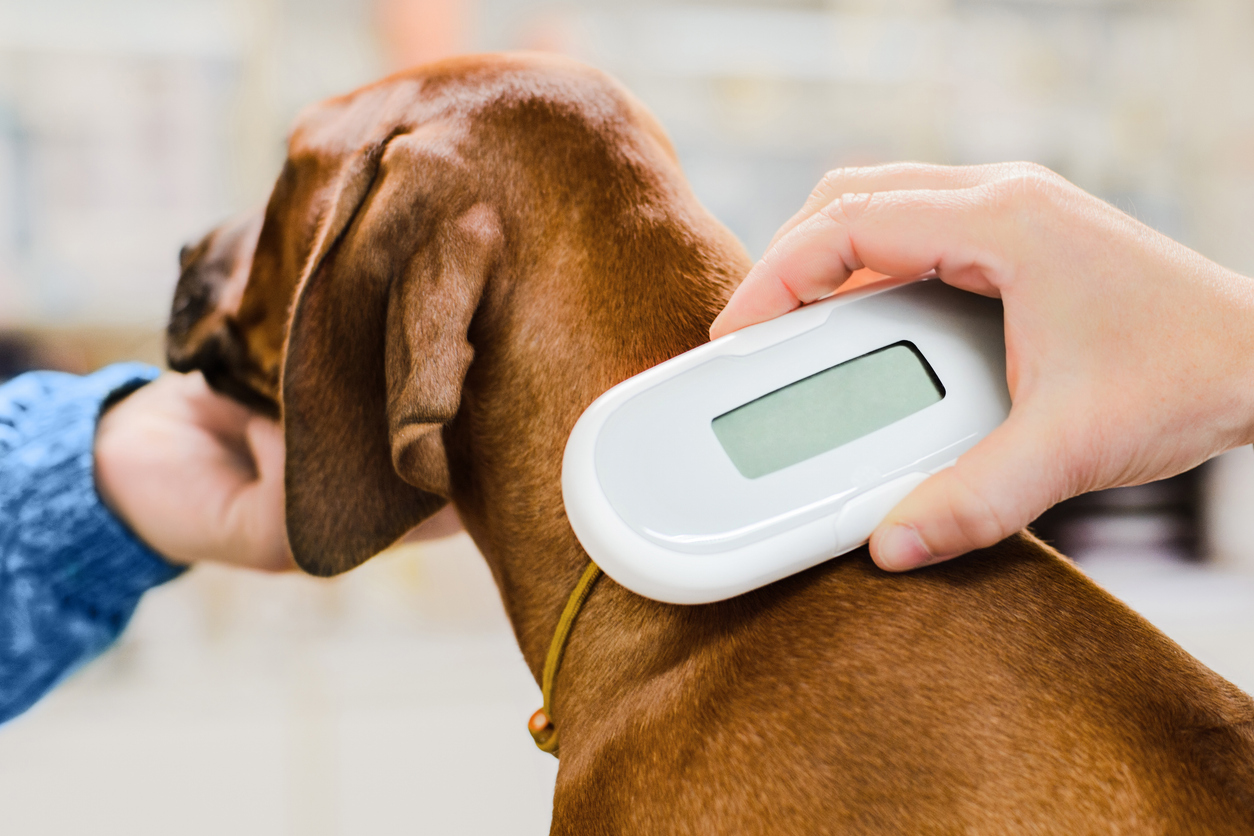
A microchip is a passive device. No battery. No signal. It cannot broadcast anything and it cannot be tracked.
It's a chip about the size of a grain of rice, implanted under your dog's skin, that stores a single unique ID number. That's it. For the chip to do anything, a scanner has to be held within a few inches of it, the chip has to be read, and someone has to look up that ID number in the registry where it's enrolled. If the chip is registered correctly, and if the person who found your dog brings them somewhere with a scanner, you get a call.
The system works. But it's reactive. It requires your dog to be found, brought in, scanned, and matched to your contact information. That process takes hours. Sometimes longer.
Think of it as a permanent ID tag that can't fall off. It answers the question whose dog is this? It doesn't answer the question where is my dog right now?
What GPS Actually Does
A GPS tracker answers the question you're actually asking the moment your dog goes missing.
You open the app, and there's a dot on a map. That's your dog. You can watch her move in real time, set up a boundary so your phone alerts you the moment she crosses the fence line, and pull up her full location history so you know exactly what path she took. You're not waiting for someone to call you. You're already driving toward her.
The limitation is practical: GPS trackers run on a battery, and they live on the collar. A collar can come off. A battery can die. Which is exactly why GPS doesn't replace the microchip.
Why You Actually Need Both
Here's how to think about it. The GPS tracker is your first move. The moment something goes wrong, you're not posting on social media and hoping. You're moving. You know what street she's on. You can share her live location with your neighbor, your partner, anyone who can help you get there.
The microchip is the last line of defense. If the collar comes off, if it gets removed, if she ends up at a shelter in a city you've never heard of, the chip is the proof that she's yours. No battery required. She can't lose it. It works decades from now.
Together, they cover the full scenario. GPS gives you real-time location when minutes matter. The microchip gives you permanent identity when everything else fails.
Both. Not one or the other.
The Fi Collar Band
The Fi Series 3 is one of the best GPS trackers available, and the collar band is the part that has to hold up every single day. LUCKY+DOG makes replacement bands in patterns and colors you won't find from Fi directly.
They're double-stitched, fitted precisely to keep the module secure through runs, swims, and everything else your dog gets into. If your current band is showing wear, or you just want something that looks right on your dog, the swap takes about a minute.